
OOG refers to cargo whose length, width, or height exceeds the inner dimensions of a standard dry container. Such cargo must be loaded into Flat Rack (FR) or Open Top (OT) containers, or shipped on a breakbulk vessel or Ro-Ro ship. Excavators, tunnel-boring machines, pressure vessels, wind-turbine blades, yachts, complete factory production lines, storage tanks and reactors — almost everything in this category.
A one-line rule of thumb: if the cargo exceeds the inner dimensions of a standard container on any axis, or its single-piece gross weight exceeds the container's rated payload, or it surpasses the terminal crane's lift capacity — if any one of these is true, the cargo must go through the OOG process.
The first step in OOG shipping isn't booking — it's choosing the right container type. Pick wrong, and either the cargo won't fit or the container won't be full — and the freight is wasted.
Container Type | Inner Length (cm) | Inner Width (cm) | Inner Height (cm) | Max Payload (kg) |
20' OT (Open Top) | 549 | 222 | 234 | 28,200 |
40' OT (Open Top) | 1,181 | 219 | 234 | 28,600 |
40' OT HC (High Cube) | 1,181 | 219 | 265 | 28,600 |
40' FR (Flat Rack) | 1,163 | 244 | 194 | 34,500 (up to 47,000 on some types) |
40' FR HC (Flat Rack High Cube) | 1,163 | 244 | 226 | 34,500 (up to 47,000 on some types) |
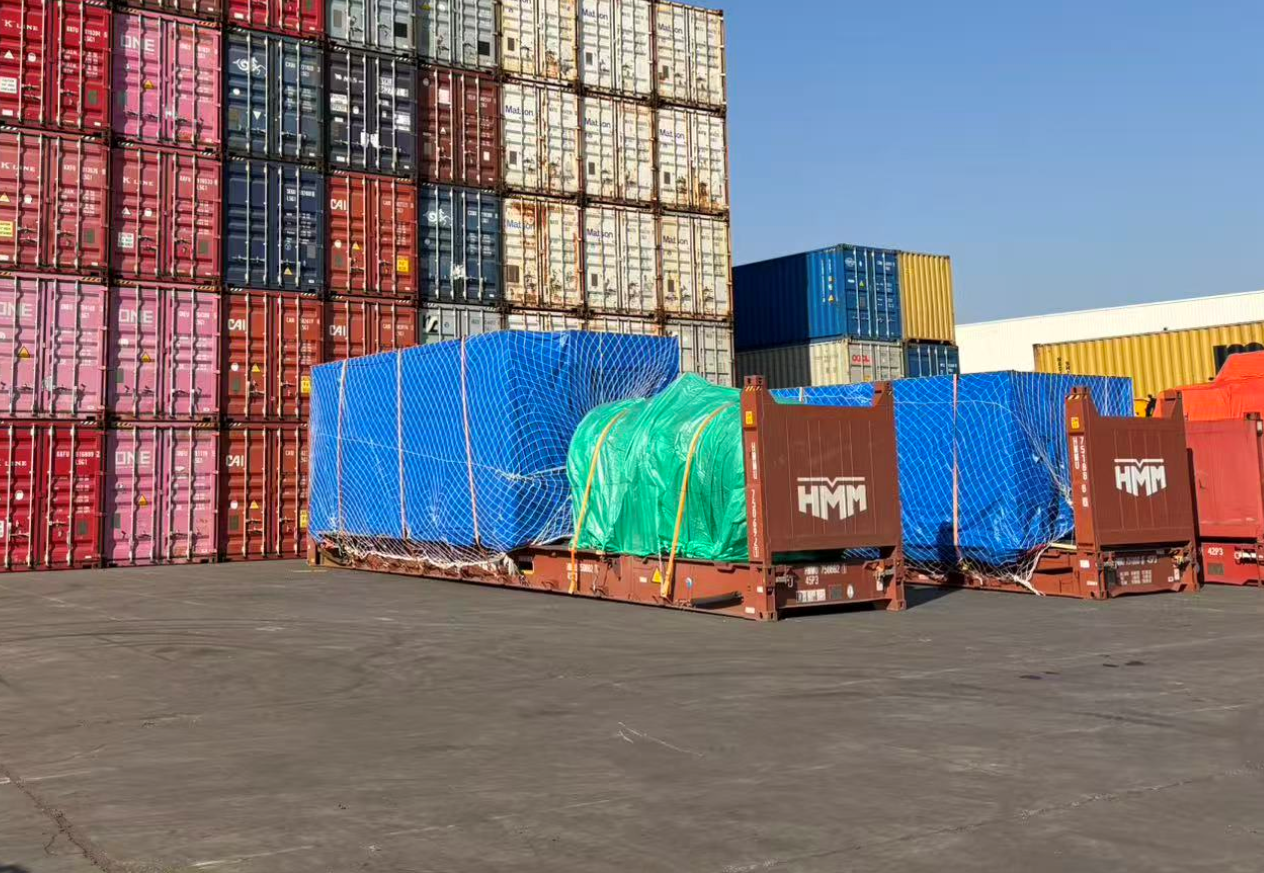
Lao Zhou's three excavators — at 9.8 m long they were pushing the 40' OT ceiling, and the 3.4 m height and 22-ton unit weight left only one real option: a 40' FR (Flat Rack) with both end walls removed and the units secured with steel strapping.
When cargo dimensions or weight exceed the 40' FR HC limits and a single piece is over 47 tons, you have to move to breakbulk deck stowage or Ro-Ro vessels — and at that point a standard freight forwarder won't be able to handle it. You need a forwarder with genuine project-cargo expertise.
Lao Zhou's first mistake was assuming "any number will do." In reality, the granularity of an OOG booking declaration is a level higher than a standard dry container. Shippers or forwarders must provide the following three categories of parameters in a single booking submission:
This is the most basic and most error-prone part.
L × W × H (in centimeters, including tolerance; margin of error ≤2%)
Single-piece gross weight (kg, including the cargo itself + lashing hardware + pallets)
Quantity (multi-piece cargo requires dimensions listed per piece)
Packaging form (wooden crate / steel frame / naked / vacuum-packed)
Center of gravity position (some carriers require a CoG diagram)
Hazardous components (hydraulic oil / fuel / batteries / residual pressure in vessels — may trigger IMDG Code dangerous-goods declaration)
Why Lao Zhou's second booking got rejected: he reported only the weight, not the dimensions, and never mentioned the center of gravity. Excavators naturally have a high CoG (front counterweight + tracked undercarriage), so without a CoG declaration the carrier simply could not judge whether the unit could be loaded safely.
This category decides whether the cargo stays stable on board — and directly affects whether the carrier approves the booking:
Loading/unloading method: side lift, top lift, forklift, or roll-on/roll-off
Lashing scheme: wire rope, chain, steel strapping, wooden wedges, welded base
Lifting-point locations: top lugs, bottom holes, side sling positions
Whether disassembly is required: shipped whole or partially dismantled
End-wall position: Flat Rack headboards (Rack) standing or folded down
Lao Zhou's rolled shipment came down to the lashing hardware hitting the corner castings — neither the shipper nor the lashing crew had realized that the four corner castings on a flat rack are exactly what the terminal crane hooks onto, and the space has to be kept clear.
This is the carrier's "compliance checklist":
OOG/BBK Reference No. (format: DD/MM/YY-XXXXXXXX, generated by the carrier at booking)
VGM (Verified Gross Mass) — required for OOG containers; BBK breakbulk is exempt; tolerance ≤±5% or 1 ton
Container number and final dimensions must be sent back within 3 hours of pickup — otherwise the loading schedule is at risk
A critical heads-up: if the actual measurements at the terminal don't match the declared data, the terminal has the right to refuse loading on the spot. Any resulting demurrage, port-change fees, and detention fees are charged back to the shipper. Major carriers such as Maersk also levy a separate Misdeclaration Fee of USD 500/container — this is not a scare tactic. Lao Zhou later heard of a peer who was fined USD 1,000 over a 3-cm measurement discrepancy (on two excavator containers).
Many first-time OOG shippers book on a standard-cargo schedule — one week out. Then they hit the approval step and discover: the carrier's approval authority for over-length, over-width, and over-weight cargo sits at headquarters or a regional center — local offices can't give an answer on the spot, and the quickest turnaround is still 2-3 business days.
Our recommendation:
Standard OOG cargo: book 7-10 business days in advance
Over-length (>12 m) or over-weight (>30 t) project cargo: book 15-30 days in advance
Holiday periods (Golden Week, Chinese New Year): add another week on top
When Lao Zhou finally turned to JYC (Shanghai) Supply Chain Co., Ltd. for help, they leveraged a special-cargo fast-track approval channel the company maintains with major carriers. The booking was approved within 1-2 business days — nearly a week faster than his first self-managed attempt. This "hidden time cost" — the approval step — is the most overlooked part of any OOG project.
OOG freight pricing is layered. Beyond the base ocean freight, the following surcharges are typical (exact amounts depend on carrier quotations):
Surcharge Item | Typical Range | Description |
OOG Surcharge | USD 200-800 per piece | Varies with degree of oversize and trade lane |
Special-Handling Fee | USD 100-300 per piece | Covers lifting, lashing, and extra yard storage |
Port Over-Dimension Operation Permit | USD 50-200 per piece | Some ports charge separately |
Misdeclaration Fee | USD 500 per container | Triggered by any data mismatch |
Demurrage / Detention | Per day | Charged for late pickup or late return |
On top of this, U.S. West Coast, U.S. East Coast, and Europe trades also stack the usual Panama Canal surcharge, ISPS surcharge, and THC (Terminal Handling Charge). We recommend that shippers ask the forwarder to itemize every line at quotation time and to sign a written price-confirmation letter before booking — verbal quotes are essentially useless on OOG projects.
OOG isn't a normal dry container — not every forwarder can handle it. When choosing, shippers should specifically evaluate:
A track record of actual special-container projects — can they show past loading photos, VGM records, and lashing schemes?
Familiarity with each carrier's special-cargo approval process — can they pre-judge approval outcomes instead of waiting for the carrier to reject the booking?
End-to-end service: trucking + ocean + customs — OOG projects break down most often at the handoffs
On-site loading supervision capability — supervising lashing and securing on site is the key to lowering rejection risk
JYC (Shanghai) Supply Chain Co., Ltd. focuses on four specialized segments: heavy-lift transport, special-cargo transport, marine-spare-parts transport, and complete-equipment-set transport. The company covers 30+ major trade lanes to the U.S., Europe, and Southeast Asia, and has long-term strategic partnerships with several mainstream ocean carriers. Shippers running OOG projects are advised to prioritize service providers with hands-on special-container experience and end-to-end service capability.
Q1: Are OOG and over-weight the same thing?No. OOG refers to dimensional oversize; over-weight refers to weight oversize. They often occur together but are conceptually separate and must be declared independently at booking.
Q2: How much dimensional error counts as misdeclaration?Carriers generally require ≤2% error margin. Even a few centimeters over can trigger a request to update the parameters or a USD 500/container Misdeclaration Fee.
Q3: Can OOG cargo go through e-commerce small-parcel channels?No. OOG cargo must be shipped via FCL (full container) or on breakbulk/Ro-Ro vessels. E-commerce small-parcel channels do not have the capability to handle special containers.
Q4: If the cargo contains hydraulic oil or batteries, is extra declaration needed?Yes. Hydraulic oil, fuel, batteries, and residual pressure in vessels can all trigger IMDG Code (International Maritime Dangerous Goods) declaration.
Q5: Does wooden packaging need fumigation?For shipments to the U.S., EU, Canada, Australia, and New Zealand, wooden packaging must comply with ISPM 15 (heat treatment + IPPC mark), otherwise the cargo will be refused entry or forced to return at the destination port.
Q6: How should I insure OOG cargo?Standard cargo insurance provides limited coverage for OOG cargo. We recommend All Risks plus a heavy-cargo extension, with the sum insured at 110%-120% of cargo value.
The core of OOG container shipping is parameter accuracy + process compliance + service-provider experience. First-time shippers almost always stumble on some step — the difference is whether they learn from one stumble or repeat the same mistakes.
If you're running or about to run an OOG project, start by getting your cargo parameters straight (dimensions, center of gravity, quantity, handling method), then sit down with a forwarder who has hands-on special-container experience to review the plan. Don't repeat Lao Zhou's first-booking detour.
JYC (Shanghai) Supply Chain Co., Ltd. specializes in heavy-lift and special-cargo transportation. The company can provide one-stop service for projects — from scheme design, inland escort, ocean booking, customs and inspection, all the way through to overseas last-mile delivery.
Disclaimer: Data in this article comes from public sources (carrier OOG guidelines, publicly available industry materials) and is provided for industry exchange and reference only. It does not constitute any decision-making advice. Actual shipping plans, parameter declarations, and surcharge amounts are subject to the service provider's formal quotation.
联系人: Manager Li
电话: 021-31056166
邮件: sea-giant@sea-giant.com
地址: Room 1708, Pu Chuang Business Building, 1050 East Daming Road, Hongkou District, Shanghai, China