
From July to August 2026, China's coastal ports are experiencing a rare "cascading congestion." On July 12, Super Typhoon Bavi (maximum sustained winds of Force 17) struck the East China coast head-on, forcing Shanghai and Ningbo — the country's largest container terminals — to fully suspend loading and unloading operations. On July 25, Typhoon Hongxia slammed into the South China Sea, disrupting operations at Shenzhen and Guangzhou ports. Before the backlogs from these two storms could be digested, the 13th typhoon of the season, Haishui (Dolphin), a severe typhoon, moved into the East China Sea on August 7, bearing down on the East China coast. Zhejiang Maritime Safety Administration activated a Level III typhoon emergency response on August 5, and multiple passenger ferry routes in Zhoushan suspended service entirely.
At the same time, August marks the traditional peak shipping season, with European and American retailers concentrating their inventory buildup for Black Friday and Christmas. The collision of typhoon-induced shutdowns with peak season cargo surges has pushed China's six core container ports — Shanghai, Ningbo, Qingdao, Shenzhen Yantian, Shekou, and Guangzhou Nansha — into a rare state of simultaneous congestion.
Kuehne+Nagel, the world's largest ocean freight forwarder, officially issued a shipping alert on July 28, designating all six major Chinese container hub ports — Shanghai, Ningbo, Qingdao, Xiamen, Shenzhen, and Guangzhou — as "Heavily Disrupted." This is a rare instance of all major domestic ports falling into large-scale congestion simultaneously.
Hapag-Lloyd's Week 31 port dynamics report, published July 27, provided specific data: at Shanghai's Yangshan port, Gemini Cooperation services averaged approximately 72 hours of waiting time, while non-Gemini services reached up to 144 hours (6 days); Ningbo averaged about 48 hours; Qingdao approximately 72 hours. Yantian averaged 6 to 36 hours, and Nansha about 12 hours. Industry estimates suggest that the combined impact of two typhoons and route adjustments has affected container capacity totaling nearly 2 million TEU.
This is not a single port's temporary malfunction, but a structural stress test of the entire national maritime system. After the typhoons passed, although severe weather subsided, the congestion crisis at major ports did not ease accordingly. Vessels that had sheltered at sea converged on ports simultaneously, disrupting original berthing plans with highly overlapping berth windows. Yard density rose rapidly, and congestion cascaded along the chain of "vessel — berth — quay crane — yard — gate — road."
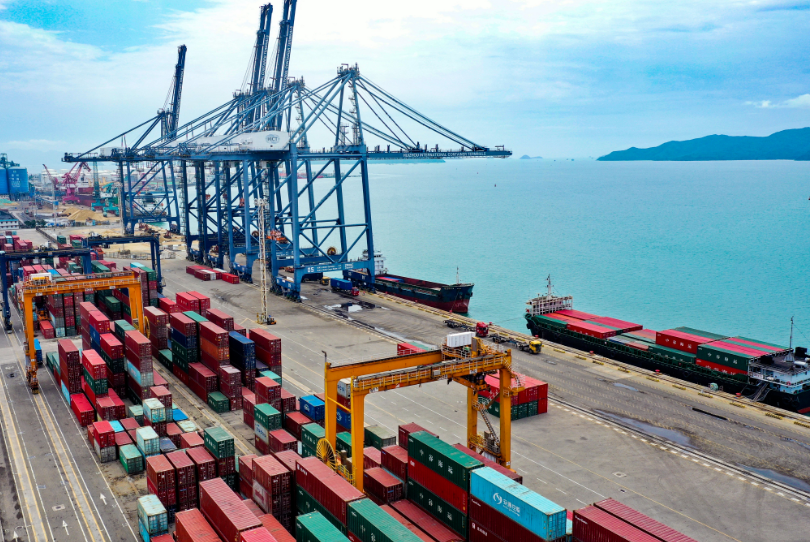
To stabilize terminal operations, two major South China terminals implemented strict gate control rules. Yantian International Container Terminal, starting July 27, enforced ETB-7 controls — only accepting export laden containers within 7 days of the vessel's estimated time of berth (ETB). Daily export container appointment slots were locked at 9,000 units, with no further intake once exhausted. Shekou Container Terminal further tightened measures on August 3, layering a 120% per-voyage container intake cap on top of ETB-7 — using the maximum loaded volume from the past 3 months as a baseline, even containers within the 7-day window cannot enter if the route's intake quota is full.
This means the margin for error for exporters has been drastically compressed. The previously flexible model of loading containers early and staging them at the terminal days or weeks before the ship arrives is no longer viable — containers loaded too early cannot enter the port and must be staged at external yards, incurring high handling and storage fees. When sailing schedules are delayed, the port entry window shifts accordingly, creating a vicious cycle.
Another driver of congestion comes from the market side. On August 1, carriers implemented a new round of GRI (General Rate Increases) on U.S.-bound routes, with increases ranging from 1,000 to 3,000 per container. The expectation of price hikes triggered panic pre-shipping among cargo owners — to beat the increase, massive volumes of cargo surged into ports precisely when they were operating at maximum capacity due to typhoon backlogs, far exceeding throughput capacity.
Carriers were also overselling capacity during peak season. Some routes saw booking volumes far exceeding actual slot availability, leading to frequent rollings. This further intensified the vicious cycle of "ships waiting for berths, cargo waiting for containers, containers waiting for yard space." Maersk issued three consecutive notices canceling Shanghai port calls on its Dragon and Northern Star services, rerouting via Xiamen or Hong Kong, disrupting original shipping plans and placing dual pressure on delivery timelines and costs for foreign trade enterprises.
Notably, Typhoon Bavi had a circulation diameter exceeding 1,500 kilometers. From July 10, Shanghai and Ningbo — the two largest ports — fully suspended container intake and pickup operations for approximately 4 days. However, the real test came not during the shutdown, but after resumption. Large numbers of vessels that had sheltered at sea arrived at ports simultaneously, and in a short period, inbound containers, loading containers, and discharging containers all surged. Shanghai Port, after fully resuming operations on July 14, maintained an average daily throughput of approximately 172,000 TEU, and on August 1 set a new single-day record of 203,881 TEU. But this "surge" data precisely reflects the depth of the backlog — the record was not achieved under calm conditions, but rather as a system-level recovery under concentrated sailings and accumulated cargo.
Port congestion has spawned a wave of hidden costs. Container handling fees (落箱费), normally 400 to 500 RMB per container, have been inflated to 800 to 1,000 RMB, with extreme cases reaching 4,000 to 6,000 RMB. Truck detention fees, re-handling fees, and secondary container return fees have risen sharply, with no standardized pricing — smaller shippers are particularly vulnerable to opportunistic surcharges.
The deeper impact lies in the complete disruption of supply chain rhythm. Containers stranded at ports and at sea have extended empty container turnover cycles from the normal 7 days to over 18 days. Export hubs in the Yangtze River Delta and Pearl River Delta face the predicament of "having cargo but no containers." Some enterprises have been forced to split shipments across air, rail, and sea channels, with air freight costing several times more than ocean freight, directly eroding profit margins. For time-sensitive cross-border e-commerce sellers and manufacturers, port congestion means not only higher freight costs but also risks of delivery defaults and customer loss.
The 13th typhoon Haishui (Dolphin) continues to approach the East China coast, the 14th typhoon Jingu (Whale) has made landfall on Luzon Island in the Philippines, and the 15th typhoon Chan-hom has also formed in the western Pacific. The coexistence of three typhoons means port disruptions will persist through August. With the peak shipping season far from over, congestion is unlikely to ease fundamentally in the short term.
For foreign trade enterprises and freight forwarders, the response logic should shift from "wait for the typhoon to pass" to proactive management. First, closely monitor weather alerts and port announcements, incorporating typhoon trajectories into shipping schedule planning, and avoid concentrating deliveries during typhoon windows. Second, strictly calculate container loading and port entry timing backward from ETB-7 rules to avoid extra storage costs from early loading. Third, diversify export ports to prevent single-port congestion from causing across-the-board delays. Fourth, maintain close communication with carriers to promptly receive information on port call cancellations and rerouting, adjusting logistics plans ahead of time.
Against the backdrop of frequent extreme weather and normalized geopolitical conflicts, the core of supply chain resilience is no longer predicting when risks will occur, but building an operational system capable of rapid response and flexible adjustment. Ports may suspend operations, but global trade does not stop — the real test begins the moment operations resume.
Disclaimer: Data in this article is sourced from public channels for industry analysis reference only and does not constitute any decision-making advice. Actual shipping arrangements are subject to official announcements from ports and carriers.
Contact: Manager Li
Phone: 021-31056166
Email: sea-giant@sea-giant.com
Add: Room 1708, Pu Chuang Business Building, 1050 East Daming Road, Hongkou District, Shanghai, China
We chat