
Complete equipment set shipping treats an entire production line, a full industrial installation, or a group of interrelated machines (injection molding lines, CNC machines, stamping lines, transformers, boiler piping, and so on) as a single project — covering factory dismantling, packing, port consolidation, ocean freight, customs clearance, and final positioning at the overseas site. The fundamental difference from general cargo: the machines have installation sequences and interdependencies. Lose one piece or damage one piece, and the entire line cannot start up.
When a production-line component fails to arrive on time, production losses can run to hundreds of thousands of RMB per day. So the core objective is not "getting the cargo there" — it is delivering it complete, undamaged, and on schedule.
A complete equipment set ranges from core machines weighing dozens of tons to sheet-metal parts and accessory boxes of a few hundred kilograms. Over-gauge pieces (over 12.2 m long, 2.44 m wide, 2.65 m high, or 24 t per piece) require flat racks, open tops, or even breakbulk vessels, while small parts travel in standard dry containers — one project often demands a mixed configuration of multiple container types, making stowage balancing and slot locking far harder than for general cargo.
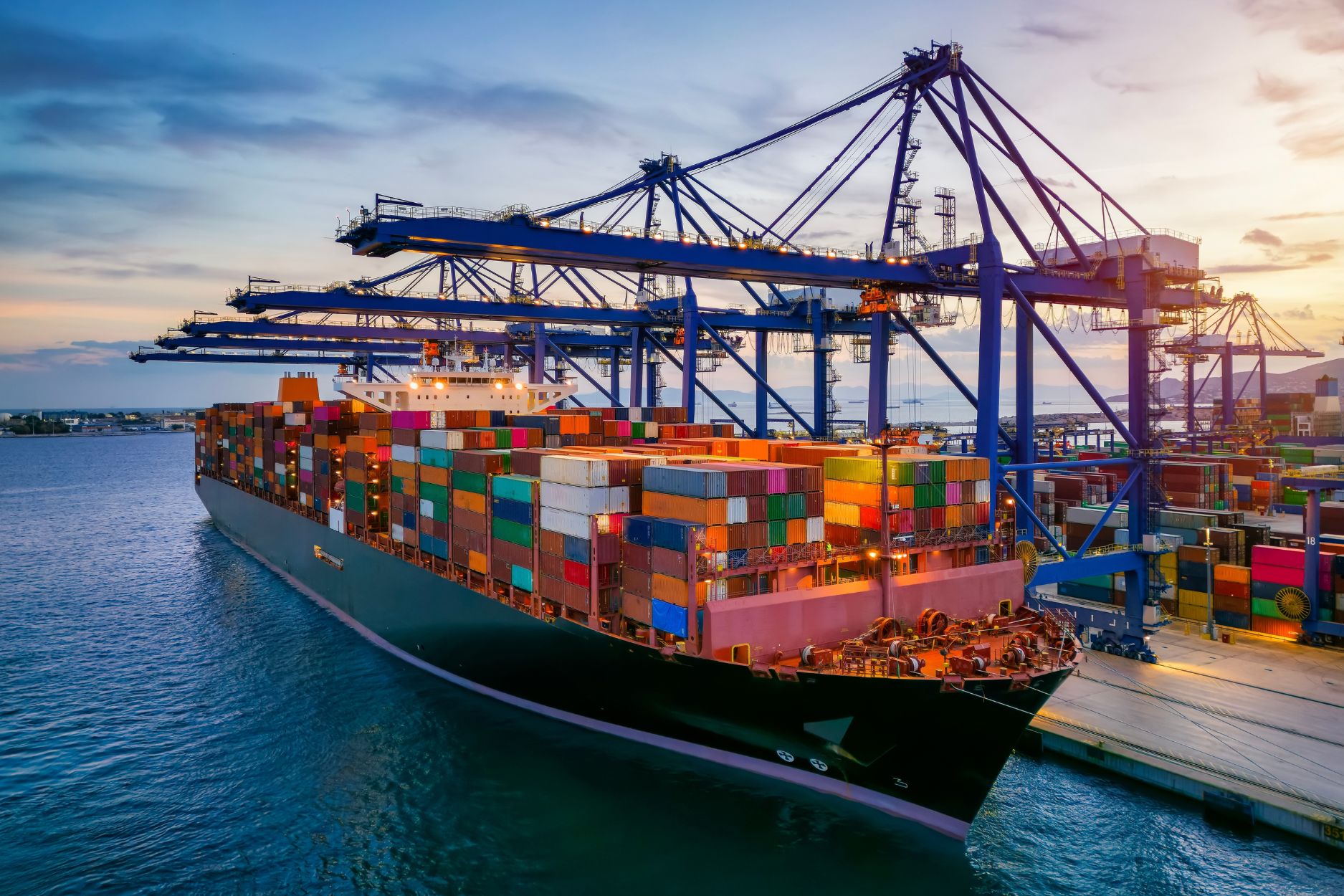
Over-gauge machines must be dismantled (SKD semi-knocked-down / CKD completely-knocked-down) and shipped in separate boxes. The classic failure mode is "dismantled and never found again":
A unique number label on every machine, mapped one-to-one to the packing list
Photograph every unit before dismantling — evidence for insurance claims
Servo motors, circuit modules, and other sensitive parts packed separately in anti-static bags
Key components numbered with their installation sequence, so overseas reassembly goes smoothly
Equipment Category | Packing Solution |
Standard equipment | Stretch film + pearl cotton + wooden/steel crate; wood must carry the IPPC fumigation mark |
Precision equipment | Fully enclosed shock-proof wooden crate + moisture protection; vacuum packing + anti-rust treatment |
Large equipment | Modular steel frame crate, base bolted down, internal cushioning and blocking |
For projects heading to high-salinity coastal regions (West Africa, Southeast Asia), precision equipment warrants dual protection: vacuum aluminum-foil wrapping plus a heavy-duty wooden crate — otherwise expect serious corrosion on arrival.
Overweight core machines need dedicated floating cranes and special stowage slots — last-minute coordination almost always means delay. Securing must follow the IMO Code of Safe Practice for Cargo Stowage and Securing: calculate the center of gravity, define lifting and load points, and produce a lashing diagram plus a materials list. Rolled shipments caused by lashing hardware blocking a flat rack's corner castings are a well-known industry accident.
A complete equipment set involves dozens of HS codes — one misclassification can swing the duty rate dramatically:
Export side: commercial invoice, packing list (with serial numbers), technical parameters, and certificate of origin (e.g., Form E) must match perfectly across all documents
Destination side: ECTN (Electronic Cargo Tracking Note) is mandatory in many West and Central African countries — miss it at the origin port and face fines or forced re-export at destination; some countries also require pre-shipment inspection (PVOC/SONCAP)
Second-hand equipment: condition certificates, years-in-service statements, and equipment photos
Factory, trucker, terminal, carrier, customs, destination broker — dense handoffs, and without a single coordinator, gaps appear in delivery, securing, and loading. A dedicated project tracker plus a milestone timetable is the baseline configuration for zero port detention.
Q1: Does a complete equipment set have to ship all at once?No. Shipments can be split by installation sequence: urgent items and core machines first, structural parts and spares later — shortening overseas waiting time.
Q2: How over-gauge does equipment have to be before going breakbulk?Beyond the flat rack limits (roughly 47 t per piece, or dimensions exceeding the rack frame), cargo moves to breakbulk deck stowage or Ro-Ro vessels.
Q3: How do I minimize customs delays overseas?Prepare the full document set in advance, pre-audit HS classifications, verify destination-country certificate requirements (ECTN, PVOC, etc.), and declare the shipment as a "complete equipment set" to pursue preferential duty rates.
Jiuyicai (Shanghai) Supply Chain Co., Ltd. focuses on four specialized segments — heavy-lift transport, special-cargo transport, marine-spare-parts transport, and complete-equipment-set transport — covering 30+ major trade lanes to the U.S., Europe, and Southeast Asia, with long-term strategic partnerships across mainstream ocean carriers. From transport scheme design, dismantling and packing guidance, and special-slot booking to customs and inspection, through to overseas last-mile delivery, the company provides full-chain project control.
Disclaimer: Data in this article comes from public sources and is provided for industry exchange and reference only. It does not constitute any decision-making advice. Actual shipping plans and costs are subject to the service provider's formal quotation.
Contact: Manager Li
Phone: 021-31056166
Email: sea-giant@sea-giant.com
Add: Room 1708, Pu Chuang Business Building, 1050 East Daming Road, Hongkou District, Shanghai, China
We chat