
Days have passed since Typhoon Dolphin swept through China's eastern coast, and both the Port of Shanghai and Ningbo-Zhoushan have resumed container gate-in and pickup operations — but for exporters and freight forwarders, the real test is only just beginning. Terminal reopening is merely the first step in clearing the backlog. The triple pressure of concentrated vessel returns, high yard utilization and truck surges is now being fully released, and the industry widely expects congestion at the two ports to persist for weeks.
From August 7 to 9, Typhoon Dolphin struck the East China coast head-on, shutting down multiple container terminals at Shanghai and Ningbo-Zhoushan for nearly three days. Ningbo began suspending operations in phases from August 7, while Shanghai's Yangshan and Waigaoqiao port areas restricted container intake and discharge from August 8. During the storm, more than 500 small and medium-sized vessels sought shelter near Shanghai, and over 800 commercial vessels anchored in the Ningbo area.
On the afternoon of August 10, Ningbo's Beilun Phase I/II/III, Meishan, Daxie and Yongzhou terminals gradually resumed heavy container operations. In the early hours of August 11, Shanghai's Waigaoqiao port area resumed heavy container operations, and the Yangshan Shengdong, Guandong and Shangdong terminals reopened simultaneously. However, reopening does not equal recovery. The surge of vessels returning to berth and the flood of accumulated containers through the gates has been dubbed a "post-reopening shock" by the industry.
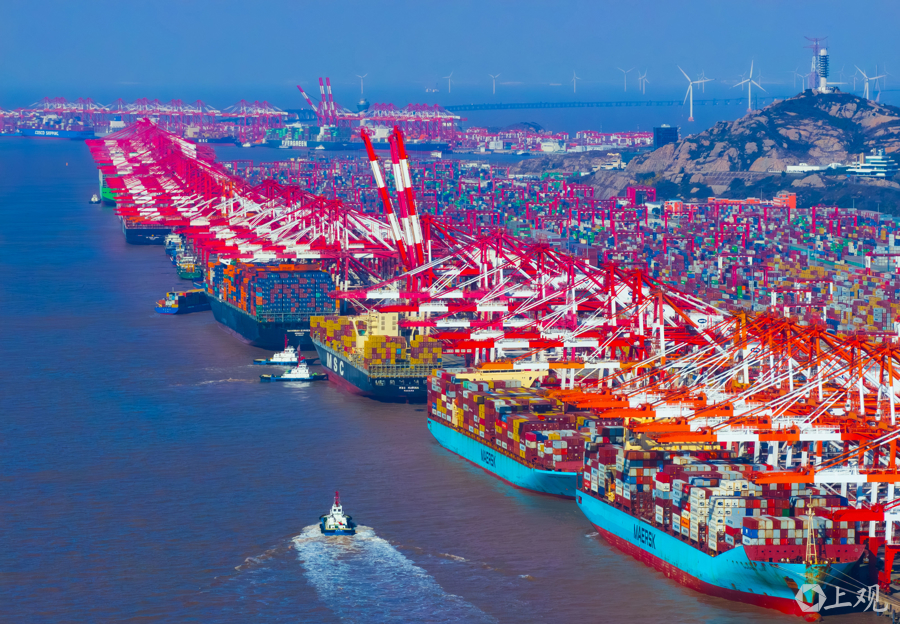
According to the latest report from shipping data firm Linerlytica, following the consecutive impact of Typhoons Bavi, Noul and Dolphin, more than 2.4 million TEU of container shipping capacity in North Asia has been delayed or stranded, with the areas around Chinese ports being the hardest hit.
Data from Kuehne+Nagel's seaexplorer shows that as of August 12, 117 vessels were waiting at anchorage in Shanghai and 60 in Ningbo. The 7-day average vessel waiting time at the Port of Shanghai reached 3.95 days, while Ningbo stood at 2.26 days, up nearly 15 hours week-on-week. Vessel arrival delays at Shanghai were calculated at 5.63 days, with departure delays at 5.37 days. Before the typhoon, average waiting times at Shanghai's major terminals had already reached 4.4 to 8 days, with some terminals hitting 8 to 12 days, and yard density generally maintained at a high 75% to 90%. At Ningbo, Meishan terminal's yard utilization approached 90%. Based on the two ports' normal throughput capacity and the shutdown period, industry estimates suggest this round of typhoons could leave more than 400,000 TEU of cargo queuing for handling.
More strikingly, seven ultra-large container vessels exceeding 20,000 TEU were awaiting berthing at Ningbo, including the 24,188-TEU OOCL Felixstowe and the 24,116-TEU MSC Raya. Seko Logistics expects berth waiting times at Shanghai to remain elevated at five to eight days over the coming week, with some Yangshan berths reaching as high as 12 days.
The congestion at the two ports is cascading rapidly along the supply chain. Seko Logistics has told clients that congestion is spreading to southern Chinese hubs such as Qingdao and Shenzhen, and Linerlytica estimates it will take weeks to clear the vessel backlog. Yangtze River feeder services will experience two to four days of lingering transit delays as mother vessels re-sequence at main ports.
The empty container issue is equally concerning. Empty container pickup at Ningbo has not been fully restored, and Shanghai's empty container operations resumed later than heavy containers — the "pick up empty, load, return full" chain has been broken, meaning even with the heavy container channel open, shippers may not be able to source empties smoothly. Europe faces a lagged impact: vessels departing late will arrive correspondingly later at Rotterdam, Hamburg and other European ports, and C.H. Robinson has already warned of potential equipment shortages and changed cut-off times downstream.
Logistics costs are rising across the board. Drop-off charges, truck detention fees and demurrage charges are climbing — drop-off fees at some terminals briefly surged from a few hundred yuan to several thousand yuan per container during the initial recovery phase. Combined with potential second customs declarations and amendment fees caused by vessel delays, per-container costs have risen noticeably. The risk of skipped port calls and rolled cargo is also increasing, with some carriers already omitting port calls and adjusting rotations to catch up on schedules.
The pace of recovery is constrained by multiple factors. First, pilotage and berth scheduling must be re-sequenced — the hundreds of anchored vessels have to queue through pilotage channels one by one, while quay cranes, yards and trucking capacity are hard constraints. Second, yard operations remain at high utilization: with density already at 75% to 90% before the typhoon, there is extremely limited turnaround space for newly arriving cargo. Third, schedule disruption produces cascading lags — late-departing vessels miss their next voyage windows, forcing carriers to "recover" schedules through skipped calls and vessel substitutions, which further postpones clearing the backlog.
More fundamentally, this is not a one-off shock. Over the past five weeks, the East China coast has been hit by three typhoons in succession — Bavi, Noul and Dolphin — keeping ports in a cycle of shutdown, resumption and shutdown again. The congestion accumulated earlier had not been fully digested before a new wave of backlog piled on top. International logistics institutions generally judge that it could take several weeks for the two ports to return to full normalcy.
For shippers and forwarders, expectations over the coming weeks should be reset to "congestion as the new normal." A few recommendations deserve immediate attention. First, avoid blindly rushing containers to the port — stagger deliveries based on terminal appointments, gate-opening times and road conditions to prevent wasted truck runs and long queues. Second, verify vessel status with carriers or forwarders in real time, as cut-off times, heavy container intake windows and appointment quotas will all shift with schedule changes; previously booked gate-in slots may become invalid, and original planned ETDs should no longer be treated as fixed. Third, build at least a week of logistics buffer into time-sensitive shipments, keep overseas buyers updated on shipping progress to manage arrival expectations, and retain terminal notices, carrier announcements, vehicle tracking records and expense vouchers in case disputes arise.
The typhoon has passed, but the congestion continues. The recovery cycle at Shanghai and Ningbo, the two hub ports, may prove longer than many expect — preparing for the worst-case scenario is the surest way to hold on to shipping certainty.
Disclaimer: Data in this article is sourced from public channels and is provided for industry analysis only. It does not constitute any decision-making advice; actual freight rates are subject to carriers' official quotations.
Contact: Manager Li
Phone: 021-31056166
Email: sea-giant@sea-giant.com
Add: Room 1708, Pu Chuang Business Building, 1050 East Daming Road, Hongkou District, Shanghai, China
We chat