
In mid-August 2026, the global container shipping market is undergoing a profound pricing transmission — rate pressure is no longer confined to the spot market but is systematically permeating the long-term contract market. Peter Sand, Chief Analyst at Xeneta, stated unequivocally in his August 13 market report: "The knock-on effect of almost half a year of disruption caused by war in the Middle East is now spreading into the long-term contract market." This means shippers face not just "how much more does one shipment cost today," but "what costs am I locking in for the coming quarter and beyond."
The spot market is the origin of this wave of rate increases — and the most intense battleground. According to Xeneta data, as of August 12, spot rates from the Far East to the US West Coast reached USD 6,965 per FEU, up 271% from the pre-crisis level at the end of February. Far East to US East Coast stood at USD 10,249 per FEU, up 287%; Far East to North Europe at USD 4,909 per FEU, up 121%; and Far East to Mediterranean at USD 5,846 per FEU, up 76%.
The Baltic Exchange weekly report of August 14 further corroborated this trend: FBX01 (China/East Asia to US West Coast) stood at USD 7,422 per FEU, up USD 410 week-on-week; FBX03 (to US East Coast) at USD 9,432 per FEU, up USD 288. Drewry's WCI showed the Asia-to-New York rate rising 10% in a single week to USD 8,706 per FEU, and Asia-to-Los Angeles up 6% to USD 6,244 per FEU. Three independent data sources all point to the same conclusion: transpacific spot rates are still climbing and remain at historic highs.
The forces driving the spot surge are manifold: ongoing Red Sea diversions absorbing effective capacity, Panama Canal draft restrictions tightening US East Coast supply, Typhoon Dolphin stranding approximately 2.4 million TEU of capacity, and robust US East Coast demand — these factors resonate together, giving the spot market's price increases a solid foundation.
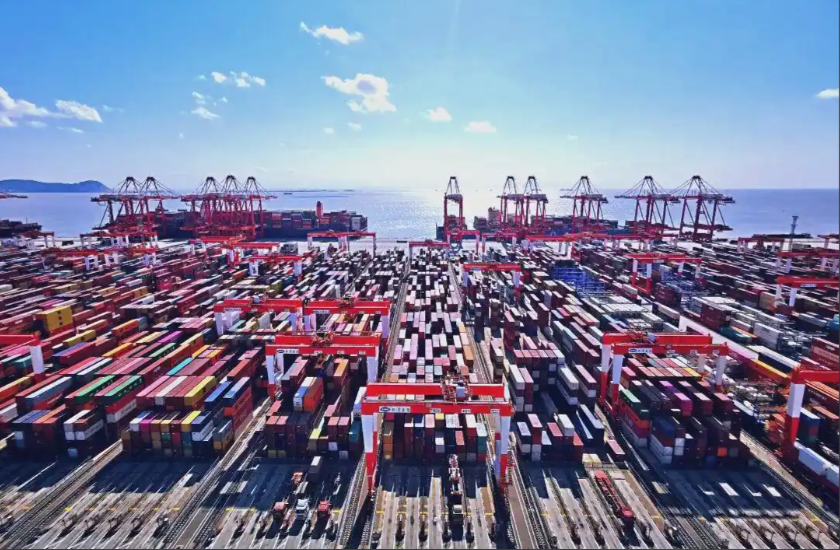
The spot market's surge is "spreading the fire" to the long-term contract market. Xeneta data shows that since the end of February, the average long-term contract rate from the Far East to the US West Coast has risen 41%, from USD 2,028 to USD 2,854 per FEU; Far East to US East Coast up 40%, from USD 3,091 to USD 4,321 per FEU; Far East to North Europe also up 41%, from USD 1,913 to USD 2,690 per FEU; and Far East to Mediterranean up 17%, from USD 2,250 to USD 2,629 per FEU. Notably, the long-term contract rate from North Europe to US East Coast surged even more sharply, by 53%.
Peter Sand described this as "the fire spreading from the short-term market." He noted that the shipping disruption caused by the Middle East war is gradually becoming a deep-seated and structural problem that will not go away anytime soon, giving carriers extremely strong negotiating power across both the long-term and spot markets — "they can call the shots across both."
The spread between spot and long-term contract rates is the key to understanding this transmission logic. Peter Sand emphasized a telling detail: before the crisis (end of February), the spot rate on the transpacific route to the US West Coast was actually lower than the long-term contract rate; today, the spot rate exceeds the long-term rate by USD 4,103 per FEU.
This enormous gap gives carriers the confidence to keep pushing long-term contract rates higher — when the spot market is quoting nearly USD 7,000 per FEU, a long-term contract signed at USD 2,800 to USD 4,300 per FEU still looks like a "discount" from the carrier's perspective. As long as the spot market remains elevated, long-term contracts have room to continue climbing. In other words, every GRI implemented in the spot market accumulates bargaining chips for the next round of long-term contract negotiations.
From another angle, this means that signing a long-term contract does not equate to "locking in a low price" — what shippers lock in is a cost that is cheaper than the spot market but 40% to 53% more expensive than six months ago. For large shippers dependent on annual tendering, this structural cost increase will reverberate throughout the entire fiscal year.
The transmission of rate pressure into long-term contracts is not evenly distributed but shows a clear "strong US, weak Europe" pattern. On US routes, spot and long-term rates are moving up in tandem — the Baltic Exchange noted that both transpacific routes "continue to trade at historically elevated levels as carriers seek to maintain pricing discipline heading into the latter part of the third quarter." Maersk's strong Q2 earnings and upgraded full-year guidance further reinforced carriers' bullish expectations.
European routes tell a different story. Drewry's WCI shows the Shanghai-to-Rotterdam rate falling 5% week-on-week to USD 4,425 per FEU, and Shanghai-to-Genoa dropping 8% to USD 5,080 per FEU, the lowest since early June. Maersk's WEEK 33 quote has dropped to USD 4,600 per FEU, MSC announced a rate increase to USD 7,800 but actual transactions fell far short, and ONE cut directly to USD 4,608. Against this backdrop, some carriers planned to introduce new FAK rates of USD 6,700 to USD 7,100 per FEU on the Asia-to-Mediterranean route from August 15, but Drewry bluntly stated that "demand weakness is challenging the sustainability of these price levels."
This divergence means that the long-term contract rate increases on US routes are backed by a supportive spot market, while European route increases face the awkward reality of "easy to announce, hard to land" — shippers have more room to negotiate on European routes but find themselves on the back foot at the US negotiating table.
Faced with the systemic spread of rate pressure from spot to long-term contracts, Peter Sand offers clear advice: "Shippers should not go out into a rising market like this and lock themselves into a one-year deal." His core logic is that a spot rate is for the "here and now," while signing a long-term contract means "accepting these elevated costs for at least the coming quarter." If the short-term market turns, shippers will be locked into high-priced contracts.
Specifically, shippers should consider three strategies. First, <strong>shorten contract duration</strong> — prioritize quarterly short-term contracts to secure space rather than traditional annual agreements. Second, <strong>embed adjustment mechanisms</strong> — include clauses in contracts that trigger renegotiation or price lookbacks when spot market indices fall below specified thresholds, avoiding being locked in at peak levels. Third, <strong>tailor strategy by trade lane</strong>: on US routes, where spot rates remain elevated and supply constraints are unlikely to ease soon, lock in space early but control contract duration; on European routes, where rates are in a downward channel, defer contracting or rely primarily on spot, waiting for lower price windows.
The spread of rate pressure from spot to long-term contracts is essentially the "financial long tail" of supply chain shocks — a capacity contraction triggered by one Red Sea diversion will not dissipate with spot rate fluctuations but will permeate cost structures for months to come through contract mechanisms. For shippers, recognizing that "transmission is already happening" is more important than predicting the direction of rate movements.
Disclaimer: Data in this article is sourced from public channels and is provided for industry analysis only. It does not constitute any decision-making advice; actual freight rates are subject to carriers' official quotations.
Contact: Manager Li
Phone: 021-31056166
Email: sea-giant@sea-giant.com
Add: Room 1708, Pu Chuang Business Building, 1050 East Daming Road, Hongkou District, Shanghai, China
We chat