
Typhoon "Dolphin" passed over a week ago, and Shanghai Port terminals have gradually resumed operations — but the port backlog has not dissipated quickly. On August 14, Maersk issued yet another port omission notice, cancelling Shanghai calls for two vessels on the Northern Star service — the sixth publicly announced Shanghai omission by Maersk in recent weeks. Meanwhile, ONE issued multiple schedule adjustment notices involving port omissions and delays of 12 to 22 days. For foreign trade enterprises and freight forwarders with shipments planned through eastern Chinese ports, the real danger is no longer "a few days late" but rather the cascade of continuous rollovers triggered by port omissions — a container gets rolled once, then gets rolled again on the next sailing, with delivery dates pushed back repeatedly.
Maersk's August 14 announcement stated that, due to regional schedule disruptions caused by recent severe weather, the SEASPAN GUAYAQUIL (voyages 627N/632S) and AS CALIFORNIA (voyages 628N/633S) on the Northern Star service would omit their Shanghai port calls. Cargo originally planned for loading or discharge in Shanghai would be rearranged to other vessels or alternative routing.
This was not an isolated event. Reviewing Maersk's omission record since July: on July 10, the Dragon service's ONE SAN DIEGO (624N/627S) omitted Shanghai due to Typhoon Bavi, with cargo transferred via Hong Kong; on July 30-31, Maersk issued three emergency notices, with Dragon and Northern Star service vessels cancelling Shanghai calls and rerouting via Xiamen and Hong Kong; thereafter the Dragon service underwent a long-term adjustment with alternating Shanghai omissions. Including this latest notice on August 14, Maersk has publicly announced six Shanghai port omissions in recent weeks.
The sheer frequency of six notices is itself a signal: the negative impact of severe weather on shipping networks does not disappear immediately when the weather clears. Downstream chain reactions persist for a considerable period.
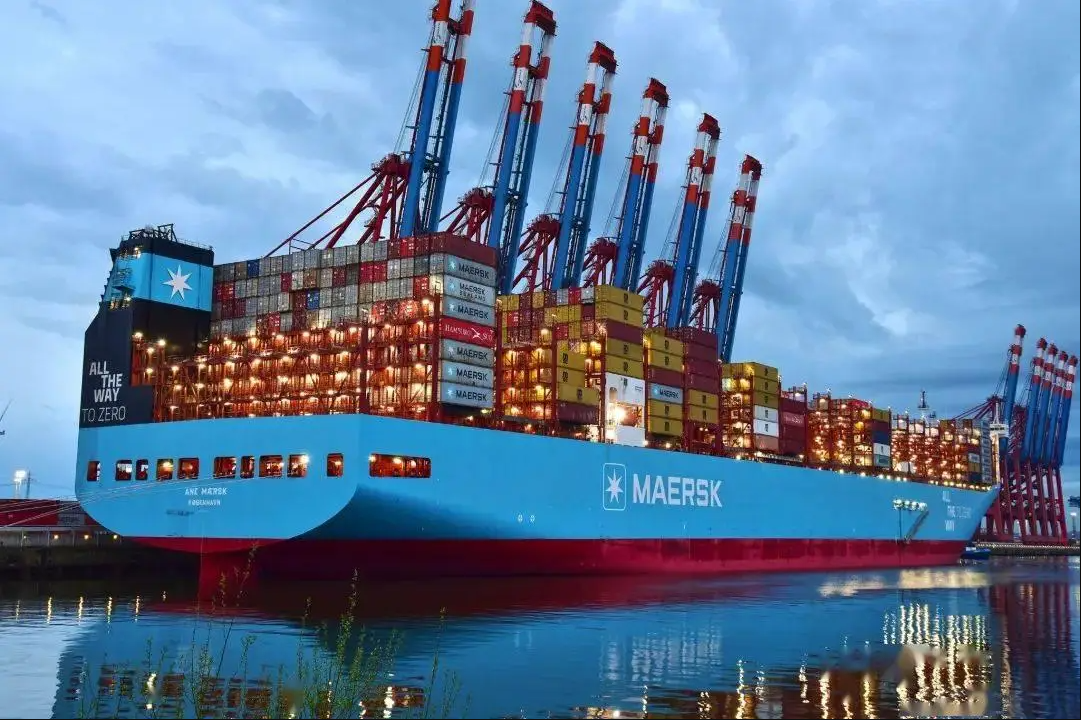
Maersk is not the only carrier making adjustments. On August 17-18, ONE issued multiple schedule adjustment notices.
On the omission front: the ONE SPHERE (voyage 2633E) on the AX1 service, originally scheduled to depart Shanghai on August 21, has cancelled its Shanghai call due to KEL terminal maintenance combined with severe port congestion.
On the delay front, the situation is even more severe. ONE's official schedule data shows:
KMTC HAIPHONG (voyage 2606N): originally planned to depart July 28, actually departed August 17 — 20 days late;
YM WISH (voyage 051W): originally planned to depart July 25, actually departed August 16 — over three weeks late;
MSC ANNA (voyage GT629W): originally planned to depart August 1, actually departed August 16 — 15 days late;
HMM HARMONY (0024S), WIDE JULIET (0121S), X-PRESS CAPELLA (26004W), ONE MEISHAN (032E), ONE SINCERITY (2630E), and other vessels experienced delays ranging from 12 to 22 days.
Some sailings' actual departure times have exceeded two weeks beyond the original ETD. This explains why shippers have been frequently encountering the following scenarios: schedules revised repeatedly, port opening notices delayed; containers already packed but unable to enter the port as planned; cargo already in the terminal but continuing to wait for the next step due to vessels arriving late or cancelling calls.
The root cause of omissions and delays is that port backlogs remain undigested.
According to Kuehne+Nagel's seaexplorer platform, as of August 16, Shanghai Port remained in a state of severe operational disruption, with the 7-day average vessel waiting time at approximately 4.42 days. While this has shortened from the peak of 12 days, some vessels at Waigaoqiao still face approximately 8 days of waiting after arriving at anchorage. Trucks have queued for up to 10 hours, and yard container density has reached 70% to 80%.
Market information indicates that approximately 200 vessels are currently waiting at Shanghai's outer anchorage. Shanghai Port and Ningbo-Zhoushan Port combined have approximately 400,000 TEU of cargo awaiting processing. At the current pace, this round of backlog may extend into September. Linerlytica previously assessed that Typhoon Dolphin had caused delays to over 2.4 million TEU of capacity in North Asia, with backlogged vessels requiring weeks to gradually clear — and current conditions are validating that assessment.
Why has congestion persisted despite the resumption of terminal operations? Three reasons: first, the effects of multiple rounds of typhoons have compounded, with previous backlogs unresolved before new suspensions disrupted berthing schedules again; second, post-resumption, vessels, export laden boxes, import pickups, and trucks all surged simultaneously, placing far above-normal pressure on berths, gantry cranes, yards, and surrounding roads; third, Shanghai Port remains in the traditional peak shipping season, and the blank sailings, delayed departures, and port omissions caused by the typhoons have further reduced effective available capacity, tightening space even more.
When a port omission notice is issued, many shippers' first reaction is "can my cargo still ship?" In reality, a port omission does not mean the cargo won't be transported — but it absolutely does not mean there's no impact.
Export cargo may be rebooked to the next sailing, or transferred to Ningbo, Busan, or other ports to rejoin the original route; import cargo may be discharged at another port first and then transshipped via feeder vessels. With additional transport nodes, delivery times become harder to predict, and the risks of transit connection failures, rollovers, and extra costs rise accordingly.
A more critical misconception: many shippers believe only Maersk's own booking customers are affected. In reality, today's shipping services universally employ alliance co-loading models, where multiple carriers share space on the same vessel. Once a sailing executes a port omission, all co-loading partners' booking customers are simultaneously affected — when a vessel skips Shanghai, cargo from multiple carriers across the entire route is forced to be rearranged.
With the port already congested, the compounding of omissions, schedule reshuffling, and cargo rebooking means some shipments face not a "single rollover" but the prospect of waiting for two or even more sailings before they can be loaded. This is the core risk of continuous rollovers: the first sailing rolls the container, and the next sailing's space is already filled by backlogged cargo from the previous omission, so the container gets rolled again. Delivery delays stretch from one week to two weeks or longer, with no definitive timeline throughout the process.
Port omissions and rollovers don't just delay deliveries — they also drive up hidden costs. Shanghai's container drop-off fees have surged from the normal level of 400-500 RMB to 800-1,000 RMB, with some periods seeing fees reach 4,000-6,000 RMB. Cargo held at off-port storage yards incurs storage fees, trucks waiting incur detention fees, and secondary trucking and port-change transshipment add further transport costs. For foreign trade orders with already thin margins, these hidden costs can easily consume all profit and even result in losses.
Additionally, cargo rebooked to other sailings may involve change fees, rate differentials, and penalty compensation for delayed delivery. Once continuous rollovers occur, shippers must also face higher-cost emergency options such as air freight replenishment and customer claims.
In the current environment, the ETD on a booking confirmation can only serve as an initial plan, not as a delivery basis. For enterprises with shipments planned through eastern Chinese ports in the near term, the following three actions are essential:
First, verify vessel status on a shipment-by-shipment basis. Before packing, confirm the vessel's current position, actual berthing window, terminal opening and closing times, and whether the sailing carries risks of omission, vessel substitution, or service consolidation. Don't rely solely on the ETD in the system — request real-time vessel position and terminal opening notices from your forwarder.
Second, prepare alternative plans in advance. Don't bet all your cargo on a single sailing. Assess the congestion levels and actual available space at nearby ports such as Ningbo and Qingdao, and confirm the feasibility and cost of alternative routes such as China-Europe rail or sea-rail intermodal. For time-critical orders, allow at least a two-week buffer.
Third, proactively manage customer expectations. Don't wait for the customer to ask. As soon as a schedule abnormality is detected, immediately issue a formal delay notice to overseas buyers, communicate amendments to letter of credit closing dates and delivery terms, and prevent subsequent commercial disputes. A sincere attitude with clear solutions will earn understanding from most customers.
What truly demands vigilance is not a delay of a few days, but the repeated postponement of delivery dates after cargo experiences port omissions, rollovers, or vessel changes. In a landscape where port congestion and schedule disruptions feed into each other, information asymmetry is the greatest risk — whoever obtains accurate schedule information first gains the initiative in the game.
Disclaimer: Data in this article is sourced from public channels for industry analysis reference only and does not constitute any decision-making advice. Actual freight rates are subject to carriers' official quotations.
Contact: Manager Li
Phone: 021-31056166
Email: sea-giant@sea-giant.com
Add: Room 1708, Pu Chuang Business Building, 1050 East Daming Road, Hongkou District, Shanghai, China
We chat