
No lockdowns, no stay-at-home consumption boom, no unprecedented container shortage — yet the queue of container ships waiting outside the world's ports is now longer than at the height of the COVID-19 pandemic in 2022.
The latest data released by shipping consultancy Linerlytica on August 24 delivered a bombshell to the market: the total capacity of container ships waiting to berth at ports worldwide has reached 4.3 million TEU, formally breaking the previous all-time high of around 4 million TEU set during the pandemic in 2022. This is yet another stress test for global supply chain resilience since the outbreak of the Red Sea crisis.
At first glance, "surpassing the pandemic peak" is alarming, but this record must be read along two dimensions.
In absolute terms, 4.3 million TEU does set a new record — equivalent to locking the entire fleet of the world's eighth-largest carrier at anchor. In relative terms, however, the record has not truly been broken: the current global container fleet stands at approximately 34.4 million TEU, meaning congested capacity accounts for 12.6% of the fleet; at the 2022 peak, the fleet was only 25.3 million TEU, and congestion once reached 15.7%.
In other words, there are more ships waiting outside ports, but that is partly because there are simply more ships at sea. The concentrated delivery of new vessels over the past three years has diluted the "concentration" of congestion, yet it also means that the absolute pressure the shipping market imposes on the port system has entered a new phase — one where historic highs can be reached even without any extreme external shock. Pandemic-era congestion was a sudden event; this round of congestion has "grown naturally" under steady demand growth and without extreme external causes — that is the more alarming signal.
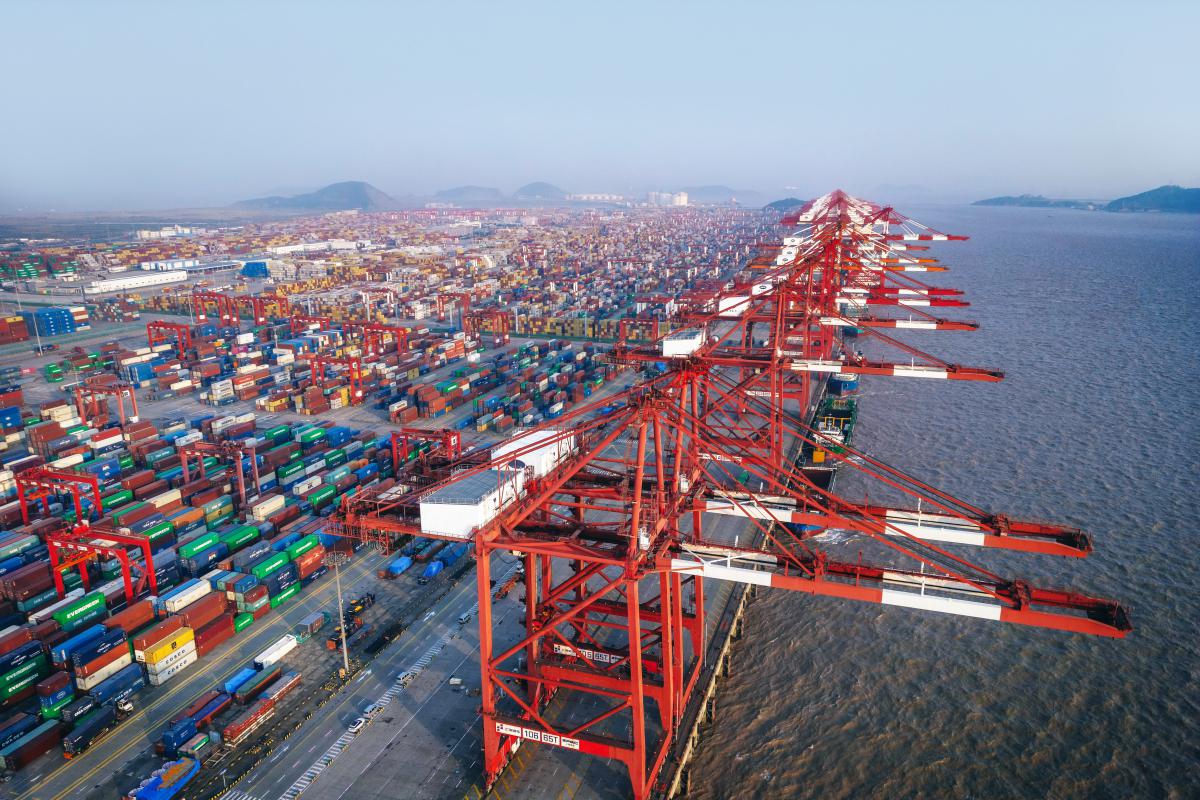
The immediate trigger of this congestion wave was a trio of typhoons striking China's coast within five weeks. Typhoon Dolphin, which made landfall on August 9, was the strongest of the three, forcing Ningbo-Zhoushan and Shanghai to suspend terminal operations on August 7 and 8 respectively, with hundreds of vessels taking shelter. Portcast data shows the Port of Shanghai once had 139 vessels waiting, and Ningbo 77 — both at their highest levels since 2025.
Waiting times are equally striking. Hapag-Lloyd disclosed that Gemini Cooperation services calling at Shanghai's Yangshan port average five to six days of waiting, while non-Gemini services wait seven to eight days; Maersk CEO Vincent Clerc previously revealed Shanghai waiting times of up to 12 days. North Asia now accounts for more than half of global congested capacity, with over 2.4 million TEU stranded by typhoons.
But zoom out, and this is long since not just an East Asian problem. Industry data shows North Europe accounts for about 13% of global congestion, with Southeast Asia, the Mediterranean, and Africa each at around 9%: Rotterdam's RWG terminal yard utilization runs at 80%-85%, and APM Terminals Maasvlakte II at 85%-90%; Hamburg, Bremerhaven, and Antwerp face persistent delays; cargo rolls have become routine at Colombo; even the US port of Savannah has seven vessels waiting. Kuehne+Nagel's seaexplorer anchorage congestion indicator shows approximately 1.85 million TEU stranded outside the 45 major ports it tracks. The typhoon was the fuse — the "dry firewood" accumulated through years of underinvestment in the global terminal system is the fundamental reason this blaze has spread worldwide.
The most direct consequence of congestion is capacity being "drained" from the market. Sea-Intelligence estimates that port delays have already removed approximately 1.7 million TEU of effective capacity from circulation — coincidentally, also the size of a top-ten global carrier. Global schedule reliability hovers at 60%-65%, far below the pre-pandemic 70%-80%; late vessels now average 5 to 5.5 days of delay, versus just 3-4 days before the pandemic.
More critically, congestion is "eating up" the rate-suppressing effect of newbuild deliveries. Global idle capacity this year is a mere 0.5%, meaning a large share of the new ships theoretically entering the market is stuck at anchor or tangled in disrupted schedules. Freight rates have therefore received powerful support: the SCFI index recently closed at 3,409.63 points, its fourth consecutive weekly gain, up a cumulative 156% since the outbreak of the Iran conflict; S&P Global's Platts container freight index rose to 7,565 per FEU on August 21, a 2026 high; Drewry's WCI shows Shanghai-to-New York at 9,507 and Shanghai-to-Los Angeles at 6,802, both extending their annual peaks. The charter market is similarly hot — Maersk just locked in two 14,000 TEU newbuildings on three-year charters at around 80,000 per day.
The Panama Canal is adding fresh pressure for the second half: due to persistent drought, daily transit slots will be cut from 36 to 34 vessels starting September 3, and further to 32 from September 15. With both of the world's key shipping chokepoints under strain, carriers have ample confidence to keep pushing rates higher — MSC and others already plan to raise US East Coast quotations by 400-500 per FEU in early September, breaking through the 10,000 mark.
Around this "record-breaking congestion," a pivotal debate is playing out within the industry.
Maersk CEO Vincent Clerc is the standard-bearer of the "structural" camp. On his Q2 earnings call, he stated bluntly that the industry's core constraint is no longer vessel capacity but the carrying capacity of ports and inland infrastructure — over the past three years, Asian export volumes have grown a cumulative 25% while global terminal capacity has expanded only 10%. "Sooner or later we are going to hit capacity limits," he said, warning that closing 15 years of investment shortfall requires a long "catch-up cycle." The congestion dividend has translated tangibly into profit: Maersk raised its full-year earnings guidance twice within two months, by 25%, lifting EBITDA guidance to $10-12.5 billion.
The opposing camp — represented by Xeneta chief analyst Peter Sand and Vespucci's Lars Jensen — argues that port congestion is merely temporary, and the Red Sea situation remains the decisive variable: once the Red Sea fully reopens and diverted capacity is released, combined with the massive newbuild orderbook, the market could quickly slide back into overcapacity.
The disagreement between the two camps is, at its core, a disagreement over "how long rates can hold." But whichever camp is right, the facts for shippers are identical right now: with 4.3 million TEU stuck outside ports, even securing a booking offers no guarantee that cargo will depart and arrive on the original schedule. Major carriers are rejecting bookings at scale, US-bound bookings now require 3-4 weeks' lead time, and the cycle of booking, waiting, rollover, and rebooking will persist.
For foreign trade enterprises, three things can be done now: build in at least one to two weeks of buffer for schedule drift; move booking windows earlier and monitor port omission advisories closely; and reduce dependence on any single port, turning multi-port, multi-route flexible layouts from an "option" into a "standard." As for when congestion will ease — until terminal investment catches up with cargo volumes, volatility itself is the norm.
Disclaimer: Data in this article comes from public sources, is for industry analysis reference only, does not constitute any decision-making advice, and actual freight rates are subject to carriers' official quotations.
Contact: Manager Li
Phone: 021-31056166
Email: sea-giant@sea-giant.com
Add: Room 1708, Pu Chuang Business Building, 1050 East Daming Road, Hongkou District, Shanghai, China
We chat