
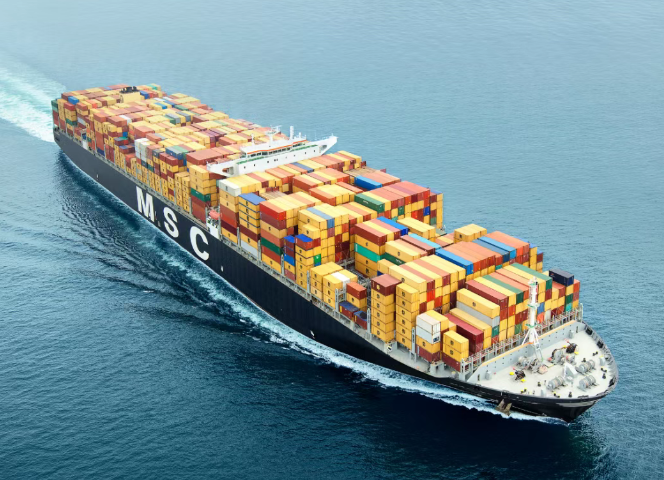
Mediterranean Shipping Company (MSC) and Hapag-Lloyd have respectively announced that they will resume regional shipping services in the Persian Gulf. Hapag-Lloyd will carry out transportation through third-party feeder vessel operators, while MSC has not yet specified the source of vessels for its operations.
On Monday, Hapag-Lloyd announced that it would resume accepting bookings for the Upper Persian Gulf region via third-party feeder services. Under the arrangement, Hapag-Lloyd will continue to use its own liner vessels to transport cargo to the Red Sea hubs of Jeddah (Saudi Arabia), Salalah (Oman), and Khor Fakkan (UAE), where transshipment will take place. From there, cargo will be further transferred via land transport and connected to feeder vessel services within the Gulf region.
Hapag-Lloyd stated: “This transport solution enables cargo flows to and from countries such as Kuwait, Saudi Arabia (Dammam), Qatar, Iraq, and the United Arab Emirates, while avoiding passage through the Strait of Hormuz.”
The company added that the feeder services will not operate on a fixed weekly schedule; their frequency will depend on local security conditions.
Meanwhile, MSC also announced a new transport route starting May 10. The plan involves shipping cargo by sea to a Saudi Arabian port, followed by cross-border truck transport to bypass the currently obstructed Strait of Hormuz.
Specifically, the service departs from Antwerp, Belgium, and calls at ports in Germany, Italy, Lithuania, and Spain before arriving at Jeddah and King Abdullah Port in Saudi Arabia. At these ports, cargo will be transferred to trucks for an approximately 1,300-kilometer land journey to Dammam. Upon arrival in Dammam, cargo will be moved via small feeder vessels to destination ports including Abu Dhabi and Jebel Ali (Dubai). These feeder vessels will also serve markets such as Bahrain, Iraq, and Kuwait. It remains unclear whether MSC will use its own feeder vessels or third-party operators for this segment.
Since March, Maersk has also adopted a so-called “multimodal landbridge” solution as an alternative route bypassing the Strait of Hormuz. Following US-Israeli strikes on Iran on February 28, passage through the Strait of Hormuz has been severely restricted, leading to significant changes in the regional shipping landscape.
Contact: Manager Li
Phone: 021-31056166
Email: sea-giant@sea-giant.com
Add: Room 1708, Pu Chuang Business Building, 1050 East Daming Road, Hongkou District, Shanghai, China
We chat